Tuesday, 16 June 2015

Day 40 - In the footsteps of St Cuthbert's Way

Today we decided to walk part of the Cuthbert's Way, to visit one of the most significant sites along the route to what is known as St Cuthbert's Cave. The cave is reputed to be where the Lindisfarne monks brought St Cuthbert's body to rest in 875AD when they fled from the repeated Viking raids on Holy Island until it was taken to its final resting place at Durham Cathedral. 


Around the site, the Leather family of Middleton Hall used this area for burials and names have been carved into the giants rocks in front of the cave. Others have also scratched names and dates.

Above the cave we had a wonderful view of Holy island and the Northumberland coastline. We follow the route through Mill Race Plantation.
On route we met several other fellow pilgrims and locals but also as we passed a farm we met one of the retired farm labours who was washing his caravan.. a Bailey, these are built in Bristol, and our first caravan was also a Bailey, after sharing caravan stories, he told us that the 30,000 acre was sold to a Dutch company a few years ago, the Diary herd of 450 cows sold, with the sheep and the diary closed down making 18 redundant. Today the farm only employs 3 part time staff and grows mainly cereals, the field being sprayed  is 50 acres of poppies - a trial venture as the seed will be used to go into poppy seed bread! 
The farm expects to get £1000 per ton, 
that a huge amount of poppy seeds!

A second retired farmer was also watching the spraying commented that no one knows how they are going to harvest it as they don't have the specialist machinery, and the combine would struggle. The consensus was next year there would be poppies growing anywhere and everywhere around the farm and fields. - Whatever happens the poppies we have seen are very beautiful.

We continued on our way.....

Monday, 15 June 2015

Day 39 - Alnwick, Downton Abbey, and John Wesley

Today we visited Alnwick, once a major town on the trading route from England to Scotland, famous today for its castle and gardens and another setting for (2014 Christmas special) Downton Abbey. There has been a castle on this site for over 1000 years. During the middle ages, the castle was used as a garrison and a defence for England’s border against attack from Scottish forces.


The Abbot’s Tower may have been a place of refuge for the head monks of Alnwick Abbey or Hulne Priory, both of which stood in Hulne Park just west of the castle. As its watchtower gives an excellent view to the north-west – the direction from which danger and Scottish attack was most likely to approach. The castle is still the country seat of the Duke of Northumberland. Alnwick’s Christian heritage is believed to go back as far as Saxon times – over 1,000 years – whilst recorded evidence covers more than 860 years. The remains of St Leonard’s Hospital Chapel stand in a field to the north of Alnwick, a short way up the hill from the Lion Bridge. The Hospital Chapel was founded between 1193-1216 in memory of King Malcolm III of Scotland, who was mortally wounded nearby in the Battle of Alnwick in 1093.

Alnwick Abbey was an abbey of Premonstratensian Canons, dedicated to the Blessed Virgin and St. James, founded in the year 1147. Only the defensive gateway tower remains.
The abbey housed between 17 and 30 canons until it was eventually dissolved by Henry VIII in 1535. The abbey was excavated in 1889 and the rough layout of the abbey buildings can be made out on the ground. 
Methodism began in Alnwick with the work of a local preacher who established a society. John and Charles Wesley arrived in 1748, and preached from the steps of the market cross,
John described the town as 'famous for all kinds of wickedness'.

However the Wesley brothers had a long relationship with Alnwick Methodist society and in 1786 John Wesley laid the foundation stone of the present chapel and Manse in Chapel Lane (which was remodelled 100 years later when the gallery was floored over, It remains in this form today.) Next door the Manse is now rented out as holiday apartments. John Wesley’s original 1786 pulpit is still preserved upstairs in the corner of the Chapel, originally it stood in an elevated position in the middle of the South Wall, and round pillars show the position and shape of the 1786 gallery that faced it. Wesley preached from this pulpit for the first time in May 1788, and for the last time on May 10th 1790, just a few months before he died.


Alnwick Methodist Church
Wesley’s journal records several of his visits including:
Sunday 17th May 1761, I preached at eight in Alnwick, and about one at Alemouth, a poor, barren place, where, as yet, there is no fruit of the seed which has been sown: but there may be, since many are still willing to hear. In the evening a multitude of people, and a little army of soldiers were gathered in the Market-Place at Alnwick. In the morning they were to march for Germany. I hope some of them have “put their armour on”
Wesley House - Former Manse at rear of church
There have been other Methodist Societies in Alnwick: Bethel Chapel in St Michael’s Lane and a chapel in Bondgate Without.
A great catastrophe happened on Christmas day in 1806. A great winter storm and the church was blown down so that the village was left without an Anglican Church. The Duke of Northumberland eventually took pity on the villagers and having bought the former granary, covered it into a temporary church until a new church was built in 1876.

Sunday, 14 June 2015

Day 38 - "I'm a vicar let me in!"

Berwick Methodist Church

A funny thing happened on the way to church this morning.... we checked on both the website and notice board for the time of the Methodist Church service 10.45am, we duly turned at 10.35 to discover that the doors were locked, soon we had an a queue of people, 5 of us trying to get in, the wooden doors remained shut and there seemed that nothing was going to happen their today.


Church of Scotland, Berwick


We took a joint decision with our fellow queue-es, to jump churches as there was a Church of Scotland opposite. The service was traditional and included Holy Communion, one interesting feature was the silver communion cup holders that slotted over the backs of the pews. We were warmly welcomed and enjoyed the service. On the way back to the car, we noticed that the Methodist Church Doors were now open!

All of this begs the question about the type of welcome we offer as churches, had someone accidentally locked the church doors or had they thought everyone had arrived, or had they forgotten/not bothered to post notices that the time had changed or the service was being held elsewhere this Sunday - it remains a mystery.  

Afterwards we drove to a National Trust property, Cragside. This is home of the first ever hydro-electricity. The Victorian ngineer, Lord William Armstrong invented and developed the first light bulb with Thomas Edison in USA and Hydro-electricity power, which he built to power the electricity in his home. The site includes a 21st century Archimedes Screw that today provides the power (in part) for the house. The house has a similar feel to Tyntesfield House near Bristol, if you have visited it you will know what I mean.


Cragside House
Archimedes Screw
During the evening we took a tour round the coast to Sea Houses as it was a beautiful evening.

Saturday, 13 June 2015

Day 37 - Lindisfarne - The Two Piligrims Way

St. Cuthbert's Way


Today we set off to visit Holy Island or Lindisfarne as part of the the 62.5 mile route of the Cuthbert's Way from Melrose to Holy Island. We intend to visit various parts of St. Cuthbert's Way during our stay and St Oswald's Way that follows part of the coastal route to Hadrian's Wall and links some of the places over 97 miles associated with St. Oswald, the King of Northumbria in the early 7th Century, who was instrumental in bringing Christianity to his people.

Bryant especially will be please to learn that we managed to drive across the causeway without incident as he presented us with a cartoon he had drawn of us getting stuck whilst towing the caravan! I am told that if you stand on Holy Island and look to the main land and see 5 poles that are clear of the tide, you have sufficient time to return by car.
Poles marking the Pilgrim's path to Holy Island.
there are 123 poles marking the safest route to the island.
During the last Ice Age sea levels rose and a small piece of land was left standing proud, linked to the mainland by sands exposed only at low tide. Originally known known as Lindisfarne - an Anglo-Saxon name where farne means retreat, it became known as Holy Island since the time of St Cuthbert. The island  has become a place of pilgrimage for Christians and over-wintering birds! Rev David Adams former vicar of Lindisfarne has helped to reintroduced Celtic Spirituality with his prayers and liturgies.We follow a spiritual walk, following the path that the early monks used hundreds of years ago.
St Aidans Catholic Church
We pass St Aidan's Catholic church as we walk into the nature reserve, we were hoping to find some "St Cuthbert's Ducks" otherwise known as The Eider Ducks of the Farnes - about 1000 breed on the islands, they have a "Greek" nose, is is white above and black below and are the largest of the diving ducks. - but none were to be seen.
Waggonway
 
We followed the original waggonway to the castle.
The ionic castle today is an old Tudor fort that was converted into an Edwardian holiday home by Edward Hudson the founder of Country Life magazine in 1901. However in Tudor times the island occupied a key position in the border between England and Scotland. In 1543, 2,000 soldiers where landed to subdue the Scots. When the two Kingdoms were united in 1603, the castle lost its role as a border fort and the garrison had only 7 men, decommissioned in 1893 it later served as a coastguard lookout station.
View of the castle from the Priory
We looked around the castle which still houses most of Hudson's original furniture.
Around the base of the castle at the waters edge various stone pillars are to be found - who and when were these made?
We continued past the harbour and saw the upturned herring boats that have been cut in half and turned into fishermen's huts.
Upturned boats
We made our way to the Priory. Holy Island has been home, at different times to two very different Christian Communities. The first monastery was of "Celtic" origin , founded by St Aidan in 635AD, a monk from Iona, the wooden buildings have completely disappeared. The monks were finally forced to leave Lindisfarne because of the Viking raids.
At the age of 17 Cuthbert decided to be come a monk after seeing a vision of angles coming to earth and returning to heaven with a shining soul. The same night he heard that Aidan had died. Aidan went to Melrose Monastery, a sister monastery to Lindisfarne as a novice.
During this period Augustine had landed at Canterbury sent by Pope Gregory as missionaries, The Celtic and Roman Church had differences of church order and traditions. These differences came to a head in 664AD at the Syond of Whitby which traditions and customs should be followed. The verdict went against the Celtic Church. Most of Lindisfarne monks decided to leave and go to Ireland. Cuthbert was appointed as the new prior with the aim of restoring morale. He also was reputed to have the gift of healing, both physical and spiritual and so people started to visit him on the island. During this period Cuthbert also felt God calling him into a life of a hermit, and moved to what is now known as Cuthbert's island.In 684AD he became Bishop of York and travelled on horseback, many hundred of miles across Northumbria.
This Domesday stone carving shows the Vikings who invaded and dates from the first century
of monastic life at Lindisfarne
The ruins seen today date from 1093 when the Benedictine monks arrived and set up a new Priory as a daughter house to Durham, which had been founded by its possession of the body of St Cuthbert! and had become the most powerful monasteries in the north-east. For most of the border conflicts, Holy Island as it was now known managed to escape, although part of the monastery was fortified. The end of Holy Island Priory came in 1537 as they had an income of only £88a year and was closed as part of the Dissolution of the Monasteries. The few monks returned to Durham, not knowing in 2 years time Durham would be forced to close as well.
A point to ponder: The Celtic monastery,with wooden huts and austere way of life, produced saints and missionaries as well as the beautiful illustrated Lindisfarne gospels (Now in the British library) the Benedictine monastery with a grand building produced nothing - no saints, no art or learning!
Ruins of the Priory Monastery 
Sharing the same site of the Priory is St Mary the Virgin Church. Originally dedicated to St Aidan, its name was changed at the Reformation when all churches had to be connected with Scripture. The church possibly stands on the spot of the original Saxon church.
St Mary The Virgin Church
Inside the church a wooden sculpture show the monks carrying the coffin of St Cuthbert through Nothumberland looking for a safe haven after escaping the Viking raids, after 100 years, they came to Durham, his final resting place.
Following the route of Pilgrims Way we stop at the URC Church, which marks the end of the route.The church has been revamp and now hosts exhibitions.
URC Church
We finish at the "Gospel Gardens" -a chance to relax before we journey back.
St Aidan

As Aidan cared for the souls of others
help me to love unconditionally.
As Cuthbert trusted in You for all his needs,
help me to have faith.
As this island has been soaked in prayer,
Help me to pray increasingly.
(Prayer from St Mary The Virgin)

We continue to pray for all those who continue to need God's healing.

Friday, 12 June 2015

Day 36 - Berwick-Upon-Tweed

We drove over the border back into England today to our next campsite at Spital near Berwick upon Tweed. John Wesley visited this border town at least 19 times according to the poster in "Wetherspoons". Berwick today is England's most northerly town. As a border town between England & Scotland it put Berwick in the frontline of conflict during the 300 years of warfare in the Middle ages. In 1115 King David I of Scotland gave a charter to the monks of Selkirk Abbey and within 10 years it had achieved the status of a royal burgh of Scotland. This year marks Berwick's 900 year history as a seaport and as Scotland's richest town. (The town changed hands 13 times from 1296 - 1482 between Scotland & England). The Tudors reinforced the town medieval walls and in 1558 new ramparts were added. - It is still possible to walk round the walls, and we plan to do that next week. 

Wesley was not over impressed by his visit in his journal for the 26th April 1751 when he recorded that he preached to a large congregation, "though the air was piercingly cold". In 1748 John Wesley preaches in Berwick for the first time to 2,000 people on Palace Green. He also records an earlier visit in 1749 Saturday 9th September. "I rode slowly forward to Berwick. I was myself much out of order; but I would not lose the opportunity of calling, in the evening, all that were “weary and heavy laden,” to Him who hath said, “I will give you rest.” Sunday. 10th September. — "I preached at eight, and at four in the afternoon; and in the hours between, spoke with the members of the society. I met them all at seven, and a glorious meeting it was. I forgot all my pain while we were praising God together; but after they were gone, I yielded to my friends, and determined to give myself a day’s rest. So I spent Monday, the 11th, in writing; only I could not refrain from meeting the society in the evening. The next evening God enabled me to speak searching words to an earnestly attentive congregation".

First things first.. check out the local Costa

View from the campsite looking across to Berwick upon Tweed
In 1549 as Archbishop Cranmer was working to promote the Reformation, and John Knox was appointed as a preacher in Berwick.  Where he preached with his characteristic passion exposing the errors of Catholicism with unsparing severity.The fame of the preacher was only extended by this feeble attempt to restrain his boldness. From a manuscript discovered in the 1870's entitled, "The practice of the Lord's Supper used in Berwick by John Knox, 1550," we know that the very beginning of Puritan practice in the Church of England in the administration of the Lord's Supper is to be found in the practice followed by Knox at Berwick, inasmuch as he substituted common bread for the bread wafers, and gave the first example of substituting sitting instead of kneeling in the receiving of communion.

Thursday, 11 June 2015

Day 35 - Reformation & John Knox


Our final day in Edinburgh saw us return to the "Royal Mile", tomorrow we upsticks and move on to Berwick. Anne was keen to return to the fudge shop as Mike had taken the last two slices back with him to Chippenham (Well he did pay for it!) I wanted to take the opportunity to visit the home of the Reformer, John Knox. Knox was born near to Haddington about 1514, and became an ordained priest, but did not serve in a Parish, but as a notary, (similar to a solicitor) and was a tutor to the sons of country gentlemen. We know little of this early life but he attended St Andrews University who at the time were keen on a Anglo-Scottish union. He was caught up in the ecclesiastical and political events that involved the murder of Cardinal Beaton  in 1546. He was taken prisoner by French forces the following year and exiled to England on his release in 1549.

While in exile, Knox was licensed to work in the Church of England  where he rose in the ranks to as  royal chaplain to Edward VI. He exerted a reforming influence on the text of the Book of Common Prayer. When Mary Tudor came to the throne he was forced into exile in Germany and Geneva and came under the influence of John Calvin.. He fell out with the Church of England because of his Calvinistic views and eventually returned to Scotland and led the Scottish Reformation.

John Knox only stayed in this house for a short time before his death in 1572

We also  crossed the 4th Road Bridge to Dunfermline to visit the Abbey and Abbots House.
The 4th Road Bridge- showing the existing road and rail bridges
and one of the posts for the new bridge, currently under  construction 
Parish Church, next to the monastery ruins.
 

Abbots House
Ruins
For over a thousand years a their has been a centre of Christian Worship on this site, the Abbey founded by King David in 1128AD was built on an earlier site dating back to 1058AD. The present church occupies the site of the ancient chancel and transepts of a large meddieval Benedictine abbey, which was sacked in 1560 during the Sottish Reformation and permitted to fall into disrepair. Ruins of the old abbey church still remain to this day.  Saint Margaret of Scotland was buried here in 1093, and today the Abbey remains as one of Scotland's most important Christian sites.

Wednesday, 10 June 2015

Day 34 - Stirling Castle

I noticed when planning our tour that many of the John Wesley tours organised in the USA include a trip to Stirling Castle. I am not aware that the Wesley's ever visited Stirling but it was a favoured home of Scottish kings and queens. Set high upon a volcanic crag, the castle provided safety and security as well as comfort and pleasure. It was here that Mary Queen of Scots was crowned queen as a baby. It was also the most besieged castle in Scotland -  the heart of the castle is the 1530's Palace, built by James V and the royal Chapel built in 7 months by James VI for the baptism of his son and heir Prince Henry.when the castle peaked as a royal residence. It still remains one of the finest examples of Renaissance architecture in the country and has recently had several rooms restored to their former glory.
Fireplace in the King's inner hall

Throughout the Castle there are numerous motifs of unicorns, including a set of seven tapestries depicting the story of the hunt of the unicorn to obtain its horn, which it was believed to have powers of purification. These are rich in Christian iconography - the unicorn represents Christ, with the maiden in the tapestries symbolises Mary the Mother of Jesus. In the climax of these tapestries the unicorn is killed but is reborn, representing the Passion and Resurrection. 

Stirling Methodist Church was built over 150 years ago and is today a lively, friendly fellowship. About 80 members plus friends and visitors make up the church. Check out their website: www.stirlingmethodistchurch.org.uk/ 

Stirling Methodist Church
Church of the Holy Rude
One of Scotland’s most important medieval churches, dating from 1456.  There is an inscription on the floor in the apse, which marks the place where King James VI King of Scots was crowned in 1567.
Street View of The Church of the Holy Rude
Argyll's Lodgings

Home of Archibald Campbell who acquired the house in 1660 who was  the 9th Earl of Argyll and a strong royalist and one of the most powerful men in Scotland during the 1600's. However in 1681 the "Test Act" was passed demanding recognition of the sovereign's supremity in spiritual and material matters. However Archibald a strong Protestant refused, and was sentenced to death. Whilst imprisoned in Edinburgh Castle he managed to escape to Holland. He returned in 1685 to lead a rebellion against James II after Charles II died who tried to restore Catholicism. The rebellion failed and his earlier death sentence was carried out without delay. 

Mar's Wark
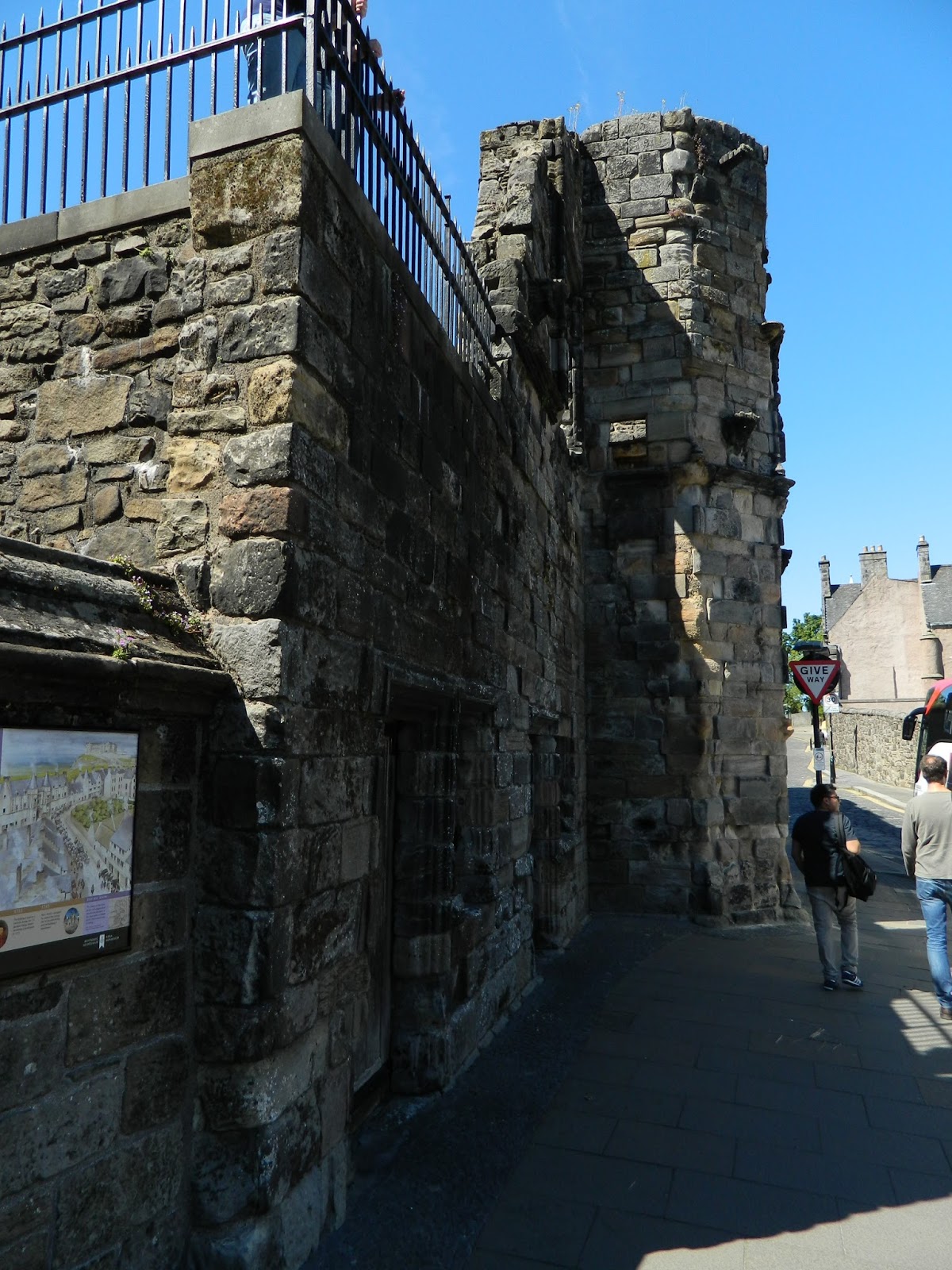
Mar Wark
All that remains of the keeper of the castle residence is a ruined facade overlooking Broad Street, originally a stately house of "hewn stone and curious architecture". The house was built using stone from abandoned monastic buildings (1598c). By 1603 the house was only occupied occasionally, so in 1733 the town council who were concerned about the vagrancy in the town secured a 57-lease to transform it into a Work House, but  14 years later the house suffered from the Jacobite Rising and major damage was inflicted on the south end and was left to decline into ruin.

Mike who has spent the last week with us flew back to Bristol this afternoon and by the time today's blog is posted he will be back home in Chippenham. It has been really good to see him in this part of our trip. Stephen will be joining us in 10 days time, so we hope the good weather continues to hold, Edinburgh was the warmest place in the UK today - what a contrast from the last few weeks!